
SIGMAR · Wetlands that clean water
This is the English summary of SIGMAR. The full portal (maps, catalogue, monitoring and citizen science) is in Spanish: ir al sitio en español.
A patented system to treat wastewater with constructed wetlands and ponds
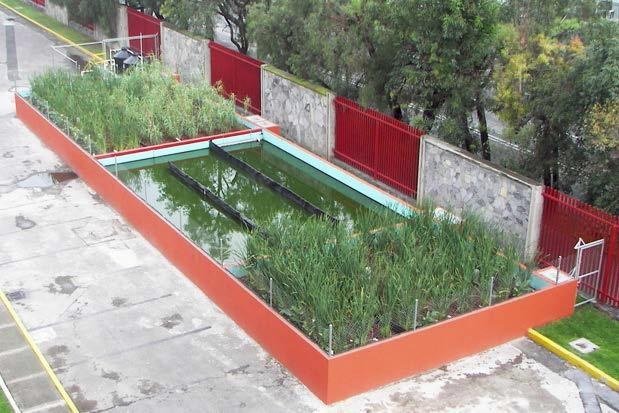
Researchers at the Universidad Autónoma Metropolitana (UAM), Azcapotzalco campus, designed a new way to build constructed wetlands and stabilization ponds: channels with banked circular curves that eliminate the dead zones where water stagnates. Water is treated more evenly and for longer, with a system that is simple to install and maintain, designed for rural communities and for water reuse in irrigation and public services.
Granted by the Mexican Institute of Industrial Property (IMPI) in 2022. Inventors: Icela Dagmar Barceló Quintal, Magdalena García Martínez and Luis Jesús Osornio Berthet.
The problem it solves
In conventional wetlands and ponds the channels are rectangular. At each channel turn the water takes a shortcut and leaves corners where it stagnates: organic matter accumulates, oxygen runs out and part of the water leaves poorly treated. The patent states that this problem had not been solved in either wetlands or ponds. Scale prototypes with a blue tracer dye showed that a circular curve, with a raised concrete bank where wall and floor meet, makes the water travel the whole turn evenly.

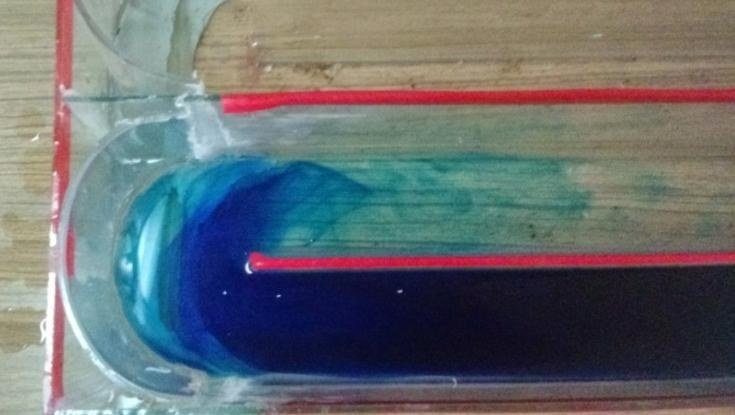
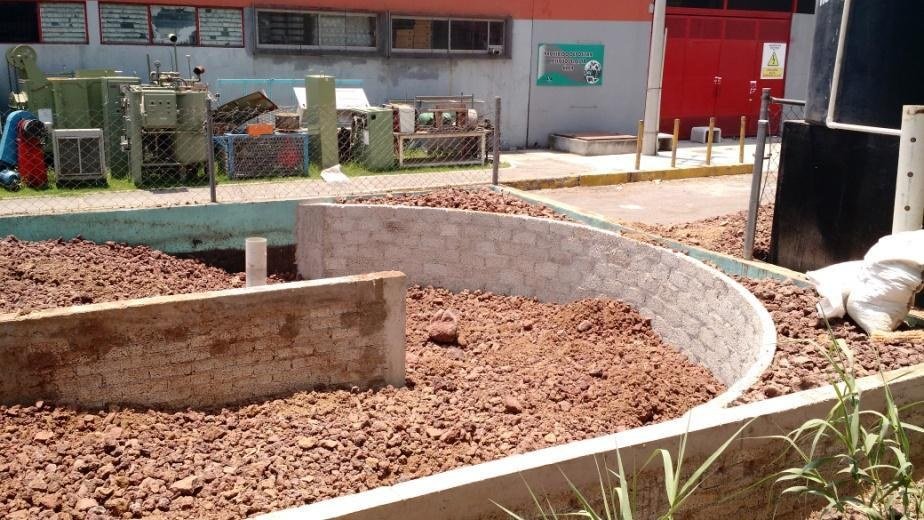
Photos: doctoral theses of M. García Martínez and L. J. Osornio Berthet, UAM Azcapotzalco, 2017.
How the patented system works
Results at UAM Azcapotzalco
The UAM pilot system was rebuilt with this design and monitored in 2016 and 2017 (doctoral theses, 2017):
The project
Project PEE-2025-G-355 builds on this patent. Its purpose is to make it known, to measure and monitor constructed wetlands with sensors and drones, and to gather the information needed to bring these systems to more communities. The portal offers a map and catalogue of the wetlands of Mexico with official layers, a monitoring dashboard for each project wetland, local climate and rainfall, a library of more than 10,000 references, and a citizen-science programme («Vigilantes de los humedales») where students and volunteers report pollution and observations with photo and location.
Evidence from other countries supports the approach for small communities: in Kothapally (India) a constructed wetland serving 100 households replaced a stagnant wastewater sump and provided irrigation water; in Masaya (Nicaragua) and San José Las Flores (El Salvador) community-managed wetlands have served about 1,000 and 650 people (World Bank/WSP, 2008; ICRISAT, 2021). Details in Spanish.
About SIGMAR
SIGMAR (Innovative Systems for Water Management and Modelling) created and develops this portal, with the participation of the Universidad Autónoma Metropolitana, Azcapotzalco, and the Instituto Politécnico Nacional through its School of Engineering and Architecture (ESIA).



Contact us (the form is in Spanish; you may write in English) · Library · Monitoring · Map