
← SIGMAR in English · Versión en español
The patent: wetlands and ponds with banked curves
- Patent: MX 396861 · Sistema de humedales y lagunas de estabilización para el tratamiento de aguas (System of wetlands and stabilization ponds for water treatment).
- Holder: Universidad Autónoma Metropolitana.
- Inventors: Icela Dagmar Barceló Quintal, Magdalena García Martínez and Luis Jesús Osornio Berthet.
- Application: MX/a/2017/011372, filed on 4 September 2017. Granted: 18 October 2022 by the Mexican Institute of Industrial Property (IMPI).
- Term: 20 years from filing (until 4 September 2037), subject to payment of IMPI fees. Classification: C02F 3/32, 3/02, 3/30.
The problem
Constructed wetlands and stabilization ponds treat wastewater at very low cost: no complex equipment, minimal operator training, no odour or noise, and the water can be reused for irrigation and aquaculture. But their channels are usually built rectangular or square. At each channel change the water takes a shortcut and leaves dead zones, mainly in the corners, where it stagnates, organic matter and sludge accumulate and oxygen is depleted. In ponds the flow also disperses, so the actual treatment time is shorter than designed.
The solution: banked circular curves
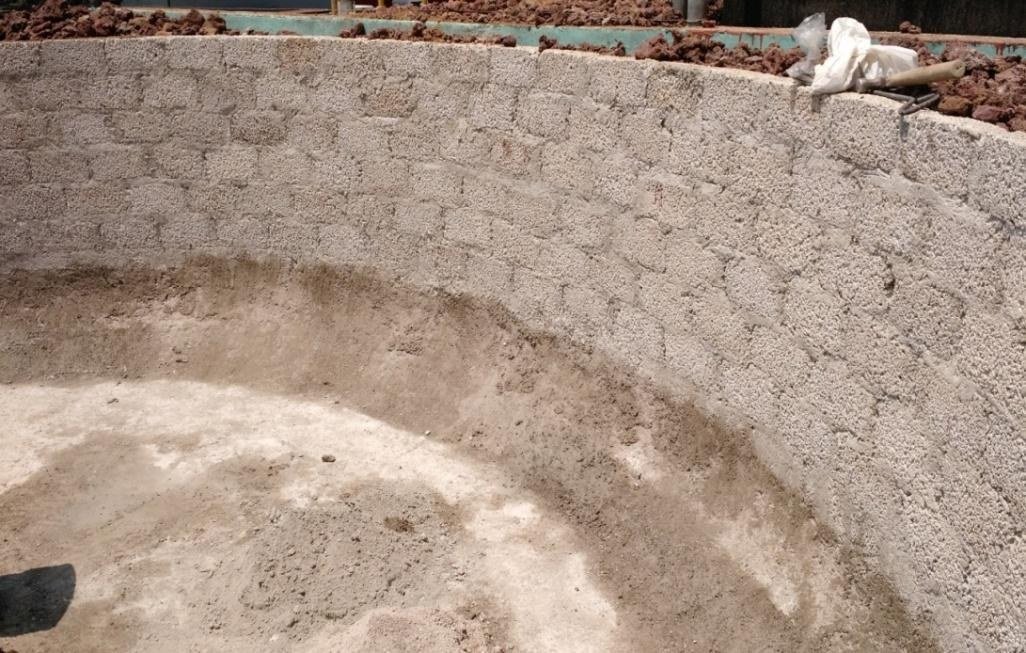
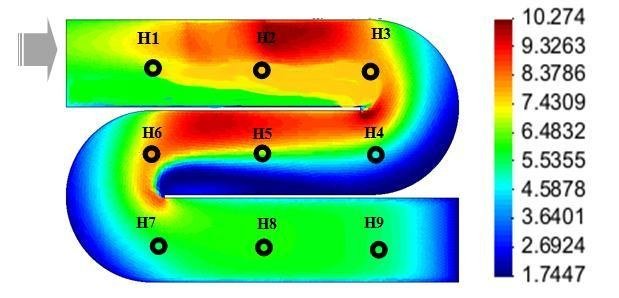
The researchers tested several shapes for channel changes in scale prototypes (hexagonal, elliptical and others), following the water with a tracer dye, and found that a circular shape gives the best transition: flow moves gradually and steadily and tangential forces are distributed evenly. They then added a bank (a triangular raised concrete section where wall meets floor, like the cross-slope of a road curve), whose angle was calculated from the forces acting on the water in the curve. The result is a more uniform flow, less dispersion and a longer retention time; and since the places where dead zones could form are known, maintenance can be targeted.
The five stages
- Pretreatment: grit chamber or settler and a screen that retains solids of 2.54 cm (1 inch) or more.
- Equalization tank: with a submersible pump, releases a steady flow of 0.05 to 0.5 L/s.
- Two-stage anaerobic digestion: two septic tanks in series ferment organic matter, partly into methane.
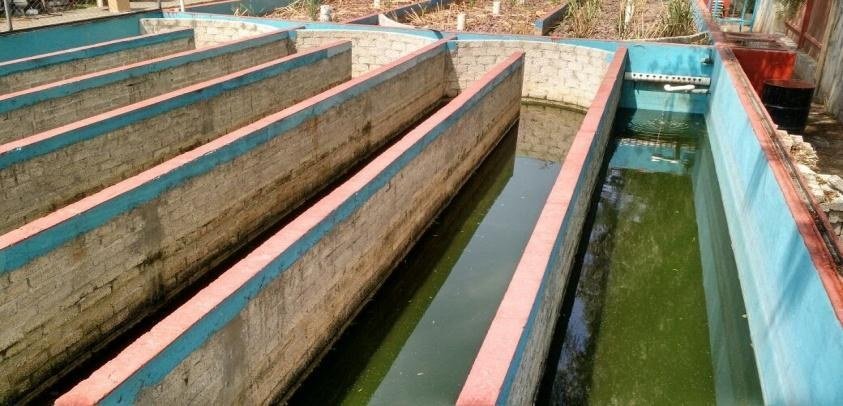
- Constructed wetland (subsurface or surface flow), fed only with the clarified supernatant: layered substrate of different grain sizes, at least two channels with banked curves, a distribution trough, common reed (Phragmites australis) and cattail (Typha latifolia), and sampling ports in each channel.
- Stabilization pond with at least two channels: contact with the atmosphere and algae reduce nutrients and pathogenic bacteria before discharge or reuse.
Evidence
The design was developed and tested in the wetland – stabilization pond – polishing wetland system at UAM Azcapotzalco, with scale prototypes (the pond at 1:20), tracer tests, IBER flow modelling and measurements of temperature, pH, conductivity, solids, dissolved oxygen, redox potential and COD. Results are reported in two doctoral theses (UAM, 2017): retention time in the pond roughly doubled with 7 channels and 6 baffles; the curves distributed flow evenly, retained solids and aerated the water; the pond reduced organic matter by 80 % (COD) and 85 % (BOD); and the whole system met the Mexican standards NOM-001-SEMARNAT-1996 and NOM-003-ECOL-1997.
To discuss applying the system, contact the UAM through our contact form. The patent title, theses and papers are in the library.